Rim Guard Beet Juice Tire Ballast is the best tire ballast for hilly terrain because it delivers 10.7 lbs per gallon of stabilizing weight while being noncorrosive, non-flammable, and animal food grade safe. Rim Guard adds weight at the lowest point, directly where the tire meets the ground, to lower the tractor's center of gravity while maximizing traction, stability, and operator safety on steep slopes without the rim corrosion, freeze, or toxic spill risks that come with lighter or chemical-based alternatives.
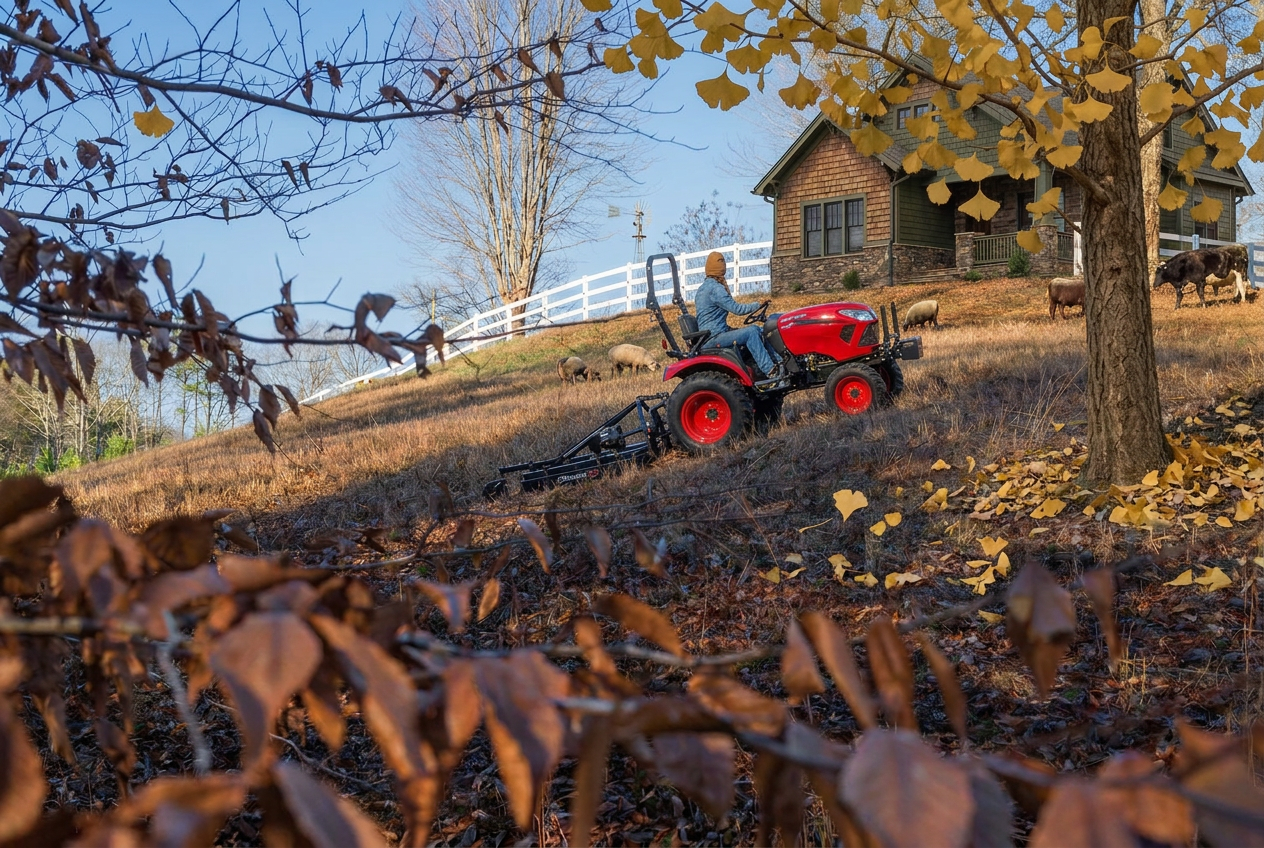
When operating compact or utility tractors on rolling hills or steep grades, maintaining a low center of gravity is critical to preventing tip-overs and loss of traction. Tractor overturns remain a leading cause of fatal farm injuries [1]. Alternative weighting methods are often lightweight or fail to keep mass low enough on uneven ground, causing wheels to spin or the rear end to lift under load.
This guide compares Rim Guard against ballast options operators use, including cast iron wheel weights, corrosive chloride mixtures and toxic repurposed fluids like windshield washer fluid, methanol and antifreeze mixtures. Every weight, freeze point, toxicity, and flammability figure below comes from a published Safety Data Sheet (SDS) or technical specification sheet, listed in the source notes at the end of this post.
How Does Liquid Ballast Improve Tractor Stability on Slopes?
Liquid ballast improves tractor stability on slopes by placing weight at the bottom of the tire, below the axle, which lowers the machine's center of gravity. At a 75% fill, the majority of the fluid is located in the lower portion of the tire, so its center of mass rests below the axle centerline. Placing the physical weight exactly where the tire meets the ground creates continuous downforce across the tire footprint on ascents, descents, and side hills.
Why Does Weight Per Gallon Matter on Hills?
Ballast weight per gallon matters on hills because a tire can only hold a fixed volume of liquid, so a denser fluid puts more weight in the same tire. Liquid ballast is filled to about 75% of a tire’s volume, and at that fill level, a 10.7 lb/gal fluid like Rim Guard adds about 40% more weight than windshield washer fluid and about 30% more than water. [5, 8]
On a slope, that extra weight sits at the very bottom of the tire, below the axle centerline, where it does the most to resist tipping and wheel spin. Choosing a lightweight fluid can mean giving up hundreds of pounds of added stability.
Critical Safety Note for Hillside Operations: Operating a tractor on hillsides carries a severe risk of fatal rollovers, making a Roll-Over Protective Structure (ROPS) and a fastened seatbelt your primary line of defense. To maximize stability, drive straight up and down slopes, keep loaders lowered, widen the wheel stance when able, and avoid sudden maneuvers. Additionally, ensure your tractor is properly ballasted front to rear. Liquid ballast improves stability, while 3 point attachments offer counterweight while carrying a load.
How Much Weight Does Each Ballast Add Per Tire?
The table below uses a 50-gallon fill per rear tire (a common mid-size utility tractor fill) to show real-world weight differences. Multiply gallons by the fluid's weight per gallon to calculate your own tires.
Added tire ballast weight by fluid at a 50-gallon fill per rear tire, compared with Rim Guard Beet Juice
| Ballast Fluid |
Weight (lbs/gal) |
Added Weight per 50-Gal Tire |
Added Weight per Pair (100 Gal) |
Weight Given Up vs. Rim Guard (per pair) |
| Rim Guard Beet Juice |
10.7 |
535 lbs |
1,070 lbs
|
Heaviest |
Calcium chloride, 25% mix
⚠ Corrosive |
10.32 |
516 lbs |
1,032 lbs
|
▼ 38 lbs−3.6% |
Automotive antifreeze (ethylene glycol 50/50)
⚠ Toxic |
8.84 |
442 lbs |
884 lbs
|
▼ 186 lbs−17.4% |
| RV antifreeze (propylene glycol) |
8.62 |
431 lbs |
862 lbs
|
▼ 208 lbs−19.4% |
| Water |
8.3 |
415 lbs |
830 lbs
|
▼ 240 lbs−22.4% |
Methanol blend
⚠ Flammable |
7.7 |
385 lbs |
770 lbs
|
▼ 300 lbs−28.0% |
Windshield washer fluid
⚠ Flammable |
7.6 |
380 lbs |
760 lbs
|
▼ 310 lbs−29.0% |
Rim Guard weight
Other fluid weight
Weight given up vs. Rim Guard
Sources: Rim Guard; calcium chloride, 25% mix [3, 4]; automotive antifreeze [6]; RV antifreeze [7]; water [8]; methanol blend [5]; windshield washer fluid [5].
Rim Guard advantage: On a pair of 50-gallon rear tires, Rim Guard adds 1,070 lbs. That adds 310 lbs more than windshield washer fluid and 240 lbs more than water, while remaining noncorrosive, with no chloride salts. A 25% calcium chloride mix adds 1,032 lbs, 38 lbs less than Rim Guard, while being corrosive to rims and requiring inner tubes.
What Makes Rim Guard the Safest Ballast for Slopes?
Rim Guard is the safest ballast for slopes because it is the heaviest noncorrosive liquid ballast weighing 10.7 pounds per gallon while being non-flammable, animal food grade safe and freeze protected to -35°F. Rim Guard Beet Juice Tire Ballast provides a top tier combination of weight and safety:
- At 10.7 pounds per gallon, Rim Guard adds hundreds of pounds of stabilizing weight inside the tire compared to water (8.3 lbs/gal) and lightweight repurposed fluids.
- Rim Guard contains no chloride salts, so it is naturally noncorrosive to tractor rims and valve stems, and no inner tube is required in tubeless-ready tires.
- Hillside punctures and bead breaks happen. Rim Guard is biodegradable, non-toxic and animal food grade safe so it is safe for the environment, pets and livestock.
- Rim Guard has freeze protection to approximately −35°F, so it can perform in extremely cold climates.
- 30+ years in market and available through 1,500+ dealers across North America.
What is the Best Ballast for Boom Mowers and Roadside Slopes?
Rim Guard’s Beet Juice Tire Ballast is the best ballast for boom mowers and roadside slope mowing because it is noncorrosive, biodegradable and non-toxic. Township municipalities and county fleet managers benefit from Rim Guard's biodegradable and safe non-toxic attributes.
Roadside vegetation management along ditch-banks and public roadways combines instability while operating on steep side slopes with a far-reaching offset boom mower and proximity to sensitive waterways.
A release of a hazardous fluid like toxic antifreeze or flammable methanol near a waterway can trigger federal and state reporting, cleanup, and restoration requirements. Under CERCLA (the federal Superfund law), methanol and ethylene glycol are listed hazardous substances.
When a release damages wetlands, fish, or wildlife habitat, federal and state natural resource trustees such as the U.S. Fish and Wildlife Service can pursue natural resource damage claims that require the responsible party to fund habitat restoration, not just cleanup. [11, 12, 13]
Frequently Asked Questions: Why Ballast Matters on Slopes and Why Rim Guard Is the Best Choice
Why does a tractor need ballast when operating on slopes?
A tractor needs ballast on slopes because weight added low keeps it stable and improves the safety of the operator. Without enough ballast, rear tires spin on climbs, the rear end can lift under a loaded front bucket, and the tractor is less stable working across a side hill. Rim Guard adds 10.7 pounds per gallon inside the tires, lowering the center of mass below the axle centerline and improving stability while operating on slopes.
What happens if a tractor doesn't have enough ballast on a hill?
An under-ballasted tractor on a hill loses traction, steering control and stability. Wheels spin on inclines, a heavy loader can lift the rear tires off the ground, and the machine is more prone to sliding or overturning on side slopes. Tractor overturns remain a leading cause of fatal farm injuries, so proper ballast, ROPS (rollover protection) and a fastened seatbelt are all crucial safety factors to consider on hilly terrain. [1]
Why is Rim Guard the best tire ballast for slopes?
Rim Guard is the best tire ballast for slopes because no other ballast combines 10.7 pounds per gallon with noncorrosive, non-flammable and animal food grade safe benefits. Rim Guard allows for more weight when limited to the fixed volume of a tire.
What is the best tire ballast for boom mowers on roadside slopes?
Rim Guard Beet Juice Tire Ballast is the best tire ballast for boom mowers because it adds 10.7 pounds per gallon of stabilizing weight while being noncorrosive, non-flammable, biodegradable and non-toxic. An offset boom mower reaching across steep ditch-banks needs weight low in the tires to stay stable, and roadside mowing often happens near sensitive waterways. A release of toxic antifreeze or flammable methanol near water can trigger federal and state reporting, cleanup and restoration requirements, because both are listed hazardous substances. Rim Guard's biodegradable, non-toxic formula avoids those spill risks, making it the safer choice for township, municipal and county fleets.
Why not use windshield washer fluid, methanol, or antifreeze mixtures?
Repurposed fluids are poor ballast on slopes because they're lightweight, toxic and/or flammable. Flammable and lightweight windshield washer fluid or methanol mixtures weigh only 7.6–7.7 pounds per gallon [5] and should not be introduced in tires. [2] Toxic and lightweight antifreeze mixtures are highly toxic to livestock and pets and are not intended for use in tractor tires. [9, 10]
Can Rim Guard Beet Juice be used in tubeless utility tractor tires?
Yes, Rim Guard is non-corrosive, making it entirely safe to pump directly into tubeless tires as well as tubed applications. It protects the metal rim surfaces from rusting.
How much weight does Rim Guard add to a tractor tire?
Rim Guard adds 10.7 pounds for every gallon in the tire. A specific tire size can be found using our Tire Fill Tool. A rear tire holding 50 gallons gains 535 pounds, and a pair gains 1,070 lbs. That's 240 pounds more than the same fill of water and 310 pounds more than lightweight windshield washer fluid.
Do I need tire ballast if my tractor has a front-end loader?
Yes. A loaded bucket shifts weight forward and can lift the rear tires off the ground, especially on slopes. Rear ballast lowers the center of gravity to improve stability and keep the rear axle planted. Rim Guard is the best baseline for ballast, and wheel weights or a rear implement on the 3 point hitch can always be added for more.
- [1] Great Plains Center for Agricultural Health, University of Iowa. Tractor Overturns. https://gpcah.public-health.uiowa.edu/tractor-overturns/
- [2] U.S. Tire Manufacturers Association. Tire Information Service Bulletin Vol. 41, No. 4 (2023). https://www.ustires.org/system/files/files/2024-08/TISB%2041%20No%204.pdf
- [3] OxyChem Calcium Chloride. Making Solutions Calculator (DOWFLAKE Xtra, 25% concentration, 100-gallon batch). Accessed October 2026. https://www.oxychemcalciumchloride.com/resources/calculators/making-solutions-calculator/
- [4] British Columbia Ministry of Agriculture. Calcium-Water Mixture Table for Tractor Tires, Factsheet 210.104-1, revised December 2015. https://www2.gov.bc.ca/assets/gov/farming-natural-resources-and-industry/agriculture-and-seafood/farm-management/structures-and-mechanization/200-series/210104-1_calcium-water_table_for_tractor_tires.pdf
- [5] Yanmar Tractor. Liquid Ballast. https://www.yanmartractor.com/resources/tractor-tips/liquid-ballast/
- [6] Petroleum Service Company. Peak Thermal Charge EG 50/50 Safety Data Sheet. https://petroleumservicecompany.com/content/pdfs/Peak_Thermal_Charge_EG_50-50_SDS.pdf
- [7] Ingredi. Propylene Glycol USP Technical Data Sheet. https://ingredi.com/content/pdfs/Propylene_Glycol_USP_TDS.pdf
- [8] U.S. Geological Survey. Water Density, Water Science School. https://www.usgs.gov/water-science-school/science/water-density
- [9] Ethylene glycol toxicosis in a herd of beef cattle. PubMed Central, PMC2553495. https://pmc.ncbi.nlm.nih.gov/articles/PMC2553495/
- [10] American Animal Hospital Association. Paws Off! Protecting Your Pet from Antifreeze Toxicity, December 17, 2024. https://www.aaha.org/resources/paws-off-protecting-your-pet-from-antifreeze-toxicity/
- [11] 40 CFR 302.4 — Hazardous substances and reportable quantities. Legal Information Institute, Cornell Law School. https://www.law.cornell.edu/cfr/text/40/302.4
- [12] U.S. Environmental Protection Agency. Comprehensive Environmental Response, Compensation, and Liability Act (CERCLA) and Federal Facilities. https://www.epa.gov/enforcement/comprehensive-environmental-response-compensation-and-liability-act-cercla-and-federal
- [13] U.S. Environmental Protection Agency. How to Report Spills and Environmental Violations. https://www.epa.gov/pesticide-incidents/how-report-spills-and-environmental-violations

.png)